Place Value Calculator
Read this number as:
✨ AI Learning Tools
Understanding Place Value Calculator: A Simple Guide to Numbers and Their Positions
Place value is the foundation of how numbers work. It tells you what each digit in a number really means based on its position. If you ever mix up why 123 is different from 321, or how to break down large numbers for math problems, this guide fixes that. We’ll cover the basics, step-by-step calculations, decimals, and how to use a tool like the Place Value Calculator to make it all clear.
What Is Place Value and Why It Matters
Every digit in a number has a specific value depending on where it sits. In the number 234, the 2 is in the hundreds place, so it’s worth 200. The 3 is in the tens place, worth 30, and the 4 is in the ones place, worth 4. Adding them up gives the full number: 200 + 30 + 4 = 234.
This system helps with everyday tasks like adding money, measuring distances, or checking bills. Without understanding place value, subtraction with borrowing or multiplication gets confusing. For example, if you’re subtracting 456 from 789, knowing place values lets you borrow correctly from the hundreds or tens.
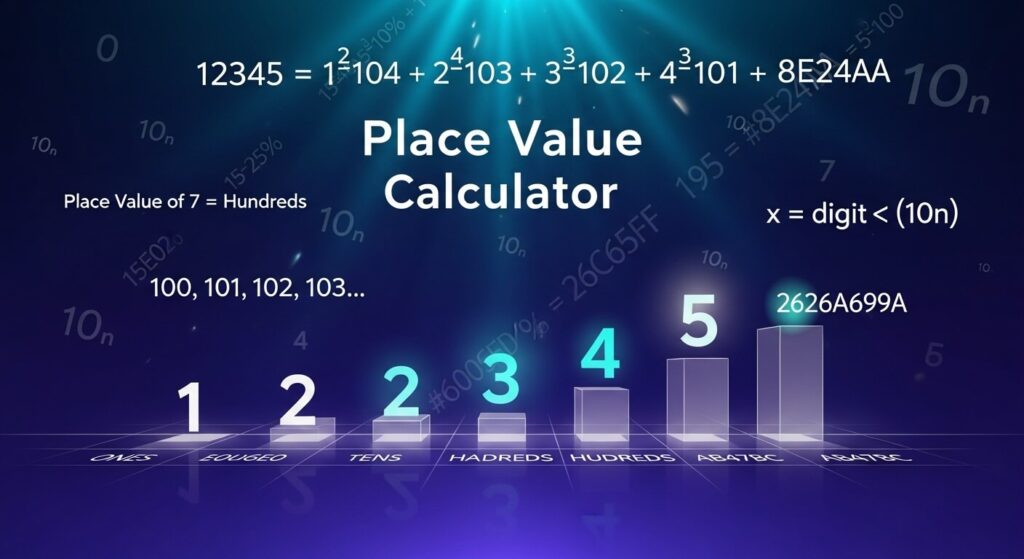
To visualize this, think of a chart where each column represents a power of 10. Starting from the right:
- Ones (10^0 = 1)
- Tens (10^1 = 10)
- Hundreds (10^2 = 100)
- Thousands (10^3 = 1,000)
And so on. This is the positional notation in base 10, where we use digits 0 through 9.
How to Build a Place Value Chart for Any Number
Creating a place value chart solves the problem of breaking down big numbers. Take 18,452 as an example. List the digits from right to left and assign places:
| Digit | Place Value |
|---|---|
| 2 | Ones (2 × 1 = 2) |
| 5 | Tens (5 × 10 = 50) |
| 4 | Hundreds (4 × 100 = 400) |
| 8 | Thousands (8 × 1,000 = 8,000) |
| 1 | Ten Thousands (1 × 10,000 = 10,000) |
Add them up: 10,000 + 8,000 + 400 + 50 + 2 = 18,452. This method works for any integer. If you’re dealing with a number like 457, it becomes:
- 4 hundreds (400)
- 5 tens (50)
- 7 ones (7)
Total: 457. Use this to verify calculations or teach kids how numbers expand.
For larger numbers, extend the chart:
- Hundred Thousands (100,000)
- Millions (1,000,000)
- Ten Millions (10,000,000)
- Hundred Millions (100,000,000)
- Billions (1,000,000,000)
This fixes issues with reading big figures, like in budgets or population stats. For instance, 1,234,567 is one million two hundred thirty-four thousand five hundred sixty-seven.
Handling Decimals in Place Value Charts
Decimals extend place value to the right of the decimal point. Each position is a fraction of 10. For 1568.23:
- 1 is thousands (1,000)
- 5 is hundreds (500)
- 6 is tens (60)
- 8 is ones (8)
- . (decimal point)
- 2 is tenths (0.2)
- 3 is hundredths (0.03)
Total: 1,000 + 500 + 60 + 8 + 0.2 + 0.03 = 1,568.23.
The decimal places are:
| Factor | Name |
|---|---|
| 0.1 | Tenths |
| 0.01 | Hundredths |
| 0.001 | Thousandths |
| 0.0001 | Ten-Thousandths |
| 0.00001 | Hundred-Thousandths |
| 0.000001 | Millionths |
To read decimals, say the integer part, then “and,” followed by the decimal as a whole number plus the smallest place. For 0.21459, it’s zero and twenty-one thousand four hundred fifty-nine hundred-thousandths.
This solves problems like measuring precisely, such as in recipes (0.5 cups) or money ($4.99). If you’re adding 2.34 + 5.67, align the decimals and add place by place.
Positional Notation: The Math Behind It All
Positional notation means each digit’s value comes from its position and the base (10 for decimals). The formula for any number is: digit × base^position.
Positions start at 0 from the right for integers, negative for decimals. For 10:
- 0 × 10^0 = 0 × 1 = 0
- 1 × 10^1 = 1 × 10 = 10
Total: 10.
This system scales easily. For bases other than 10, like binary (base 2), it’s the same idea but with powers of 2. But in daily math, base 10 rules.
If you’re converting from another base to decimal, multiply each digit by the base raised to its position and sum. This fixes conversion errors in computer science or puzzles.
Spelling Numbers Using Place Value
Spelling numbers correctly avoids confusion in writing checks or reports. Use the place value chart to group digits in threes.
- Ones, tens, hundreds: Basic units.
- Thousands: For 1,000 to 999,000.
- Millions: For 1,000,000+.
- Billions: Even larger.
For 457: Four hundred fifty-seven (hyphen between twenty-one and ninety-nine).
For decimals like 0.21459: Zero and twenty-one thousand four hundred fifty-nine hundred-thousandths.
Practice with charts to get it right every time.
Common Problems and Quick Fixes with Place Value
Here are fixes for frequent issues:
- Misreading large numbers: Break into groups of three from the right. For 1234567, it’s 1,234,567 – one million, two hundred thirty-four thousand, five hundred sixty-seven.
- Borrowing in subtraction: If subtracting 456 from 789, borrow from hundreds if tens are short. Understand places to avoid mistakes.
- Multiplying decimals: Count decimal places in factors and place the point accordingly. Place value shows why.
- Comparing numbers: Align by place value. 123 > 99 because hundreds digit is higher.
- Rounding: Look at the place you’re rounding to and the next digit. If 5 or more, round up.
Use these steps to handle schoolwork or real-life math without errors.
Introducing the Place Value Calculator: Your Tool for Easy Calculations
The Place Value Calculator takes any positive integer or decimal and shows the full chart. Enter a number like 234, and it displays:
- Digit: 2, Place: Hundreds
- Digit: 3, Place: Tens
- Digit: 4, Place: Ones
It also reads the number in words: “Two hundred thirty-four.”
For decimals, it handles tenths, hundredths, etc. If you enter invalid input like letters or negatives, it shows an error message to guide you.
This tool fits right into your workflow – no full-page takeover, just the calculator in a modern, attractive design with clean borders and buttons.
Advanced Features: Learn and Practice with AI
The Place Value Calculator goes further with AI-powered tools to build skills.
Explain Place Value Button
Click this after entering a number for a step-by-step breakdown from Google’s Gemini AI.
- Instant Breakdowns: For 5,280, it explains: The 5 is in thousands (5,000), 2 in hundreds (200), 8 in tens (80), 0 in ones (0).
- Tailored to Your Input: It matches exactly what you entered, making explanations personal.
- Simple Language: Breaks concepts into short paragraphs, like a tutor. Fixes confusion for students or parents refreshing on topics.
This feature turns passive calculation into active learning, helping with homework or test prep.
Create a Word Problem Button
Generate real-world problems based on your number for practice.
- Real-Life Applications: For 234, it might create: “If you have 234 apples, with 2 boxes of 100 each, how many tens and ones are left?”
- Endless Variety: Each click gives a new problem, perfect for unlimited drills.
- Engaging Practice: Turns numbers into stories, like budgeting or measuring, to make math fun and relevant.
Use this to apply place value in contexts like shopping or sports scores.
Place Value in Other Bases: Expanding Your Knowledge
While base 10 is standard, understanding other bases solves problems in computing. In base 2 (binary), places are powers of 2: 1, 2, 4, 8, etc.
To convert 1010 (binary) to decimal:
- 0 × 2^0 = 0
- 1 × 2^1 = 2
- 0 × 2^2 = 0
- 1 × 2^3 = 8
Total: 10.
The Place Value Calculator focuses on base 10, but knowing this helps with tech-related math.
FAQs: Quick Answers to Common Questions
How do I make a place value chart for base 10?
- Split the number into digits.
- Assign powers of 10 from right (ones) to left.
- Multiply each digit by its place.
What is the place value of 1568.23?
- 1: Thousands
- 5: Hundreds
- 6: Tens
- 8: Ones
- 2: Tenths
- 3: Hundredths
How does place value work in other bases?
Multiply digits by base^position and sum. For base 10 conversions, it’s straightforward.
What is a place value chart?
A table showing each digit and its multiplied value based on position.
Wrapping Up: Master Place Value Today
With this guide and the Place Value Calculator, handle any number confidently. From basic charts to AI explanations and word problems, these tools fix math hurdles directly. Practice regularly, and place value becomes second nature for school, work, or daily life.